We are trained as anthropologists and tend to maintain a healthy distance to social engineering, but as stewards of a vast collective memory of global cultural experimentation, it could be argued that we have an obligation to share these alternative ideas and ideologies with nonanthropologists seeking visions of a sustainable world. Like so many other populations over the past few centuries, the Tiv have discovered how their incorporation into a world economy orchestrated by general-purpose money implied loss of local control, inequitable trade relations, and environmental degradation [2007:65].Very often, policy makers and other social scientists assume the experience of Western peoples defines the boundaries of possibility (see this link for an interesting, but long, study in which the study populations used by the discipline of psychology are scrutinized...how representative of a general human species are those results?). However, as Hornborg argues above, there are other ways and other possibilities and should not be discounted out of hand as "backward" survivals from a more primitive stage of human cultural evolution.
Showing posts with label Ant 101. Show all posts
Showing posts with label Ant 101. Show all posts
Tuesday, March 5, 2013
Expanding Possibilities
The following quote from Hornborg's article struck me as I was reflecting on discussion in 101 yesterday.

Wednesday, February 6, 2013
Anthropological Approaches...Interrupted by Fire and Finished Friday
Adding to the previous post, the remainder of influential ideas and approaches in anthropology. This and the last post are not at all an exhaustive list, but I believe it does provide a general sense of the direction of the discipline. On Friday, we'll recap a bit more and I'll emphasize those elements that remain common practice.
Friday, February 1, 2013
Approaches in Anthropology...so far
Just a quick overview of the theoretical approaches in anthropology that we've covered so far. I'm going to try my best and distill the major points as well as those elements that remain with the discipline.
Friday, January 25, 2013
Points of View
This post is to hopefully recap a bit of the discussion from today's class.
While anthropology has traditionally focused primarily on culture, I tried to emphasize other aspects of the human experience and how they articulate with culture. However, it might be best to think of the four divisions I used as different angles from which to look at the same thing...humans.
Friday, August 31, 2012
Holistic Connections
This post primarily stems from Friday's discussion in the Archaeology course, but it's relevant for the Cultural one as well.
Friday, April 13, 2012
Race, Social Construction and Mortality
Thanks to many of the posts examining race over at Living Anthropologically , I got turned onto Lance Gravlee’s 2009 article, “Race Becomes Biology.” There are a lot of reasons to like the article, but in particular, he brings attention to a recurrent problem I have when talking about race to students. Students definitely do usually interpret the traditional anthropological critique of race as “oh, anthropologists say race doesn’t exist, so it’s not important.” And while that’s clearly not what I’m arguing in class, it’s painstakingly difficult to clearly articulate the nuance.
Thursday, March 15, 2012
Geographies of Gender
As usual, this is my place to reemphasize, and hopefully clarify aspects of class discussion. In Wednesday's class, I attempted to outline how I see the construction of gender in the US and many other Western societies. That's when I put forth that gender in the US is binary, mutually exclusive, ascribed and static.
Many of you rightly noted the role of self-identity and variation on gender roles based on people you know from your own experience. Those are important facets of gender (and culture in general) since all individuals and groups internalize and express culture in partly idiosyncratic ways.

I'm a big fan of metaphors to help explain and understand concepts. Taking an idea from one domain of experience to another can at times, facilitate the establishment of connections that might be unclear otherwise. Here, I think the metaphor of a map is helpful. Maps try depict spatial information by simplifying. That's what I was trying to do with gender. What's the basic gender road map that folks use in US culture? While people can and do go "off road," their path is more difficult than those following the pre-established paths. And, in many ways, their particular route is defined largely by its deviation from the major road. I hope that helps some.
Many of you rightly noted the role of self-identity and variation on gender roles based on people you know from your own experience. Those are important facets of gender (and culture in general) since all individuals and groups internalize and express culture in partly idiosyncratic ways.

I'm a big fan of metaphors to help explain and understand concepts. Taking an idea from one domain of experience to another can at times, facilitate the establishment of connections that might be unclear otherwise. Here, I think the metaphor of a map is helpful. Maps try depict spatial information by simplifying. That's what I was trying to do with gender. What's the basic gender road map that folks use in US culture? While people can and do go "off road," their path is more difficult than those following the pre-established paths. And, in many ways, their particular route is defined largely by its deviation from the major road. I hope that helps some.
Friday, March 9, 2012
Walking Marriages
Here's a youtube clip of the Mosou, who also practice the "walking marriage." The clip provides an extended illustration of the practice, its consequences and changes into contemporary life.
Wednesday, March 7, 2012
Pair Bonds and Promiscuity
This is my attempt to retroactively make the end of class today in anthro 101 a bit more coherent.
 What I was attempting to argue was that, as a biological species, human beings have both a heritage of pair bonding and promiscuity...and every possibility in between. For those interested in a highly readable and complete review of some of the evidence for the biology of human sexual interactions, check out Patrick Clarkin's series of blog posts beginning here.
Our specific cultural background(s) then shape how that plastic/flexible sexual predisposition is expressed. That's what we'll get into on Friday when we discuss the diversity of forms of marriage found in the ethnographic record.

Our specific cultural background(s) then shape how that plastic/flexible sexual predisposition is expressed. That's what we'll get into on Friday when we discuss the diversity of forms of marriage found in the ethnographic record.
Friday, March 2, 2012
Kinship as Basis for Social Action

The formation of networks and groups is also one of the primary functions of human kinship. It gives form and shape to human sociality. It provides avenues for the dissemination, negotiation and modification of symbols.
Of course, kinship is still important to us, but so are other forms of social interaction. So, despite the fact that some of the societies often used as case studies in anthropological examinations of kinship seem very different than our own, there's a basic similarity between what they're doing and what you do.
I also just came across what seems to be a massive website, Kinship Studies, dedicated to assembling resources for the anthropological study of kinship.
Wednesday, February 29, 2012
Anthropology and Kinship
As discussed briefly today, anthropology has long focused on kinship as it's been a central organizing principle for most societies. Even our own, with its many, overlapping institutions and identities, kinship ties remain some of the strongest, most meaningful and longest lasting (I still talk to my parents, but most friends from high school I now only interact with through Facebook).
 On Friday, we'll continue with the description of diagramming relationships, particularly with what criteria we use to organize and classify kin. Then, with a broad brush, we'll look at the kinds of social groups and networks that conceptions of kinship create. Kinship has been and remains one of the most important ways that humans activate and actualize social cooperation.
For all of you kinship nerds out there (and I know there were some), I just stumbled across this site, which seems to provide a freeware program to depict and model kinship groups.

For all of you kinship nerds out there (and I know there were some), I just stumbled across this site, which seems to provide a freeware program to depict and model kinship groups.
Monday, February 27, 2012
Overlapping Economies
Just a quick note that I wanted to add to class lecture. Today, I tried to dissect the concept of an economic system by explicitly teasing apart allocation, production, distribution (and consumption..though I didn't mention it). Dissecting even further, I separated types of distribution--specifically looking at varieties of reciprocity.
 In an actual society, most or all of these aspects of economies overlap. For instance, while the US economy is dominated by market exchange and a capitalist mode of production, we all also participate in household (sort of like kin-ordered) modes of production and in a variety of reciprocal exchanges.
Societies like the Ju/'hoansi simply are much more dominated by communal modes of production and reciprocal economies.
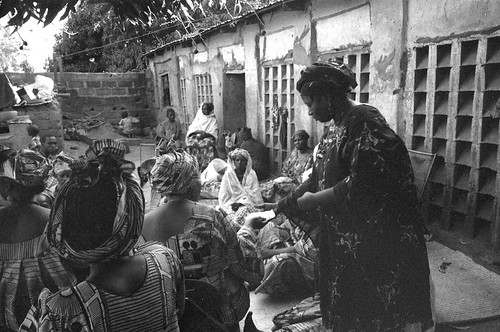
Societies like the Ju/'hoansi simply are much more dominated by communal modes of production and reciprocal economies.
Subscribe to:
Posts (Atom)